Soil Carbon Tracks the Rain: A Caution for Carbon Monitoring
Most conversations about building soil carbon focus on management: no-till, cover crops, better rotations. Those practices work, and the long-term trends they produce are real. But there’s a shorter-term signal riding on top of that trend that’s easy to miss and expensive to misread: soil carbon moves with the weather. This study set out to measure how tightly.
A decade of data from one farm
The analysis drew on 3,861 agronomic soil samples collected from the top 15 cm across roughly 4,700 hectares of a southeastern Saskatchewan farm, over 2013 to 2022. I paired the soil organic matter record with total annual precipitation from the nearest weather station, and compared five-year moving averages of each to look at the direction both were trending rather than the noise of any single year.
The two move together
The result was striking in its simplicity.
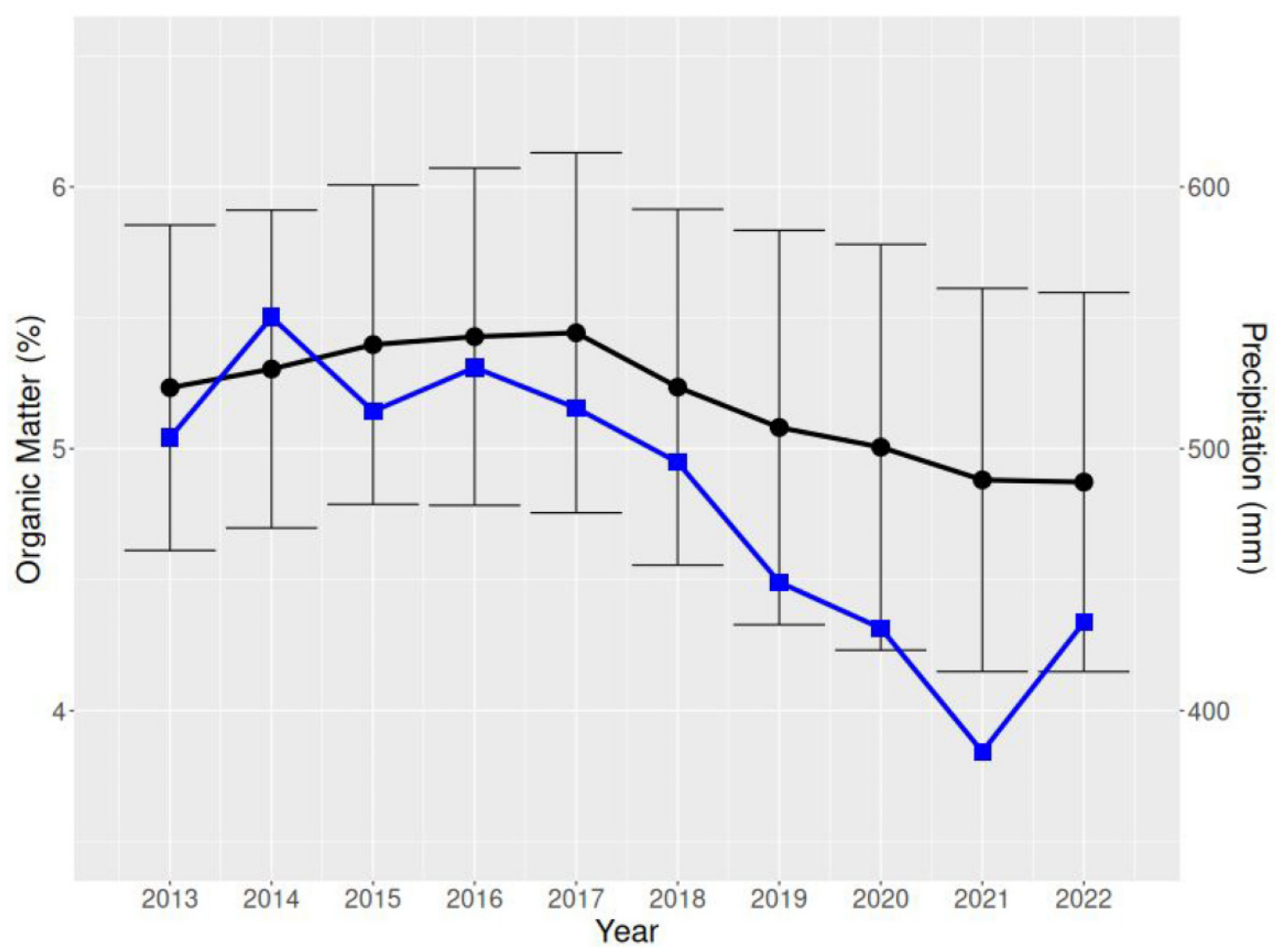
Soil organic matter and precipitation were highly correlated (r = 0.91). The relatively wet years through 2017 coincided with higher soil organic matter; the dry stretch that followed brought a clear decline, bottoming out around 2021 when both precipitation and soil organic matter hit their lowest point. Temperature, by contrast, showed only a weak relationship in this dataset, rainfall was the dominant climate lever.
The likely mechanism is straightforward: in drier years, crops produce less biomass, so less carbon returns to the soil as residue and roots. That reduction in carbon inputs appears to matter more than any change in decomposition rate, and it shows up quickly in the more labile fraction of soil organic matter.
Why this is a monitoring problem, not just a curiosity
Here’s where it matters for carbon markets and MMRV. If soil carbon can swing by this much in response to a few wet or dry years, then a monitoring window that happens to fall in a dry stretch can show a “loss” that has nothing to do with management and one that lands in a wet stretch can overstate the gain. The same field, honestly measured, can look like a success or a failure depending purely on when you sampled relative to the rainfall cycle.
Concretely: a project could bank a real management gain over its first five years, then post an apparent decline over the next five simply because of below average rainfall even as the underlying, management-driven trend stays positive. Read either window in isolation and you’d draw the wrong conclusion.
The implication isn’t that soil carbon monitoring is unreliable, it’s that it has to be done with the climate signal explicitly in view. Credible measurement, reporting, and verification need to separate the weather-driven swing from the management-driven trend, whether by normalizing for precipitation, using climate-matched baselines, or monitoring over windows long enough for short-term cycles to average out. Attributing a rainfall-driven change to a farming practice, in either direction, is one of the easier ways to get a soil carbon number wrong.
The takeaway
Long-term soil carbon gains from good management are real and worth crediting. But over the few-year horizons that monitoring programs actually operate on, precipitation can dominate the signal. Any soil carbon assessment that doesn’t account for it is at risk of measuring the weather and calling it management.
This article summarizes: Sorenson, P. T., & Bedard-Haughn, A. K. (2025). Soil organic matter is responsive to short-term climate cycles. Canadian Journal of Soil Science. https://doi.org/10.1139/cjss-2024-0103